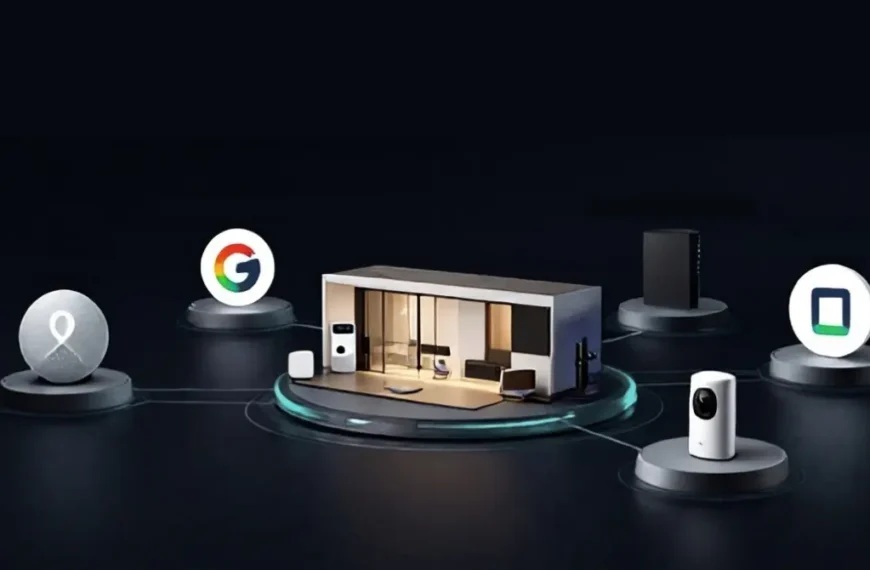
The IoT and domestic automation landscape is experiencing an unprecedented architectural shift. For years, the industry relied heavily on centralized cloud infrastructure, rigid binary conditional logic (IF/THEN), and fragmented proprietary radio protocols. Today, modern smart home platforms are executing a rapid transformation toward edge-first processing, natural language understanding powered by Large Language Models (LLMs), and unified cross-vendor communication fabrics. This evolution addresses long-standing challenges in latency, user privacy, system reliability during cloud outages, and the technical debt associated with maintaining disparate vendor APIs.
Software engineers, system integrators, and technology architects are no longer building simple event-driven automation routines. Instead, they are engineering distributed, context-aware automation engines capable of processing unstructured spatial and visual data directly at the edge. By combining local hardware acceleration with standardized application layers like Matter and network layers like Thread, the modern home ecosystem is evolving into a cohesive, resilient, and ambient computing platform.
The Paradigm Shift in Modern Smart Home Platforms
Historically, domestic automation systems relied on cloud-tethered pipelines. A smart switch pressed in a living room would transmit an encrypted packet across an internet service provider’s network to a vendor’s remote data center, process the conditional rules within a cloud-hosted database, and return an execution command to a light bulb situated mere feet away from the switch. This architecture introduced inherent single points of failure, network latency bottlenecks ranging from 300 to 1,500 milliseconds, and severe privacy concerns regarding the continuous streaming of telemetry data.
From Static IF/THEN Logic to Dynamic LLM Automation
Traditional rule engines require explicit instruction for every environmental state. Developers had to write discrete conditionals for motion detection, ambient light levels, time-of-day constraints, and occupancy states. If an edge case fell outside these defined parameters, the system failed to deliver the intended user outcome.
Next-generation smart home platforms replace rigid state machines with flexible, contextual AI evaluation pipelines. By placing LLM nodes within the local automation loop, systems can process natural language, evaluate real-time multi-sensor contextual data, and make dynamic inferential choices. For instance, rather than evaluating whether a motion sensor tripped between 10:00 PM and 6:00 AM, an AI-augmented automation engine can evaluate camera feeds, audio signatures, and historical patterns to deduce whether an occupant requires low-level path lighting, emergency intervention, or zero automation response.
The Rise of Edge-First Computing: Latency, Privacy, and High Availability
The transition toward local-first architecture is driven by three key software engineering imperatives:
- Deterministic Latency: Local execution over local local area networks (LAN) or mesh topologies reduces control loop latencies to below 50 milliseconds, providing instantaneous response times for critical switches, access controls, and safety systems.
- Zero-Trust Privacy Architecture: Processing audio logs, continuous camera streams, and behavioral telemetry locally prevents sensitive personal data from leaking to third-party ad networks or central cloud servers.
- Fault Tolerance and Offline Resilience: When wide-area network (WAN) connectivity degrades or fails completely, local edge hubs retain full access to local routing tables, state machines, and automation databases, maintaining continuous operational integrity.
Generative AI and Edge Intelligence in Consumer Ecosystems
The integration of Generative AI into consumer automation hubs is redefining the boundary between cloud processing and edge capability. Major industry players and open-source communities are taking distinct architectural approaches to embed dynamic inference into everyday automation workflows.
Google Gemini and Natural Language Video Analytics
Google has overhaul its home automation intelligence layer by embedding Google Gemini models into its cloud and hybrid edge processing pipelines. This integration enables sophisticated semantic search across continuous video logs. Users no longer need to scrub through hours of security camera footage or configure complex motion-zone triggers. Instead, the system processes visual frames and generates dynamic metadata tags, enabling natural language semantic queries such as “Did the dog spend time outside during the rainstorm this afternoon?” Furthermore, developers can leverage Google’s updated automation interfaces to construct multi-stage conditional flows derived directly from dynamic natural language triggers.
Home Assistant and Private, Offline AI Pipelines
In contrast to cloud-reliant approaches, the open-source platform Home Assistant has spearheaded local-first AI execution through its “Year of the Voice” initiative and native integration of offline Large Language Models. By executing light-weight quantized LLMs directly on local single-board computers, edge gateways, or local neural processing units (NPUs), Home Assistant allows users to interact with their environment using full natural language processing without transmitting a single byte of voice data outside the local network perimeter.
Developers configuring a local voice assistant for smart home systems can bind customized system prompts to local tool-calling frameworks. This capability allows local models to interpret vague commands—such as “Make the living room feel like a cozy movie theater”—and automatically translate them into precise API calls across lighting, HVAC, and media playback subsystems.
We worked through that pipeline in detail in Local Voice Assistant for Smart Home: Offline & Private, where speech recognition runs on the hub instead of a cloud API.
Apple Intelligence and Apple Home Context Engine
Apple’s smart home strategy leverages the computational capabilities of local Apple TV and HomePod hubs backed by Apple Intelligence. By maintaining local vector indexes and context maps directly on device, Apple Home manages spatial awareness and user presence locally. Instructions issued to Siri are parsed using privacy-focused on-device models, ensuring that context evaluation, device state queries, and automation scripts execute within the local security enclave before synchronizing encrypted status updates to iCloud.
Amazon Alexa: The Transition to Subscription-Based LLM Engines
Recognizing the limitations of legacy slot-matching intent engines, Amazon is refactoring the core architecture of Alexa toward a next-generation LLM backbone (frequently referenced as “Alexa Plus” or “Remarkable Alexa”). This transformation attempts to migrate hundreds of millions of legacy voice units from keyword-matching trigger mechanisms to dynamic, multi-turn conversational agents capable of complex orchestration across third-party smart home skills.
Protocol Standardization Across Smart Home Platforms: Matter and Thread
Historically, the biggest barrier to widespread adoption of automation systems was extreme hardware and protocol fragmentation. Developers were forced to build and maintain separate integration codebases for Zigbee, Z-Wave, Bluetooth Low Energy (BLE), custom Wi-Fi HTTP endpoints, and proprietary cloud-to-cloud integrations.
Matter 1.2 and 1.3: Unifying Device Data Models
Governed by the Connectivity Standards Alliance (CSA), Matter has emerged as the universal application layer protocol for smart devices. Built upon standard Internet Protocol (IP) networking, Matter provides an abstracted, object-oriented data model that standardizes how endpoints define their endpoints, clusters, attributes, and commands.
The release of Matter 1.2 and Matter 1.3 significantly extended the specification beyond basic lighting, switches, and simple sensors. The updated standards introduce unified data structures for:
- Major Appliances: Refrigerators, room air conditioners, dishwashers, and laundry machines.
- Robotic Cleaning Infrastructure: Vacuum cleaners with full mapping, mode selection, and operational status reporting.
- Energy Management Systems: Electric vehicle (EV) supply equipment, solar inverters, grid ties, and real-time power measurement devices.
- Media and Security: Enhanced control endpoints for video streaming components and environmental security sensors.
Because major platform providers—including Google, Apple, Amazon, Samsung, and Home Assistant—fully support Matter, a device certified under the specification can be controlled simultaneously across multiple ecosystems via Matter’s Multi-Admin controller topology without requiring cloud bridge hacks or vendor-specific API keys.
Thread Mesh Networking: The IPv6 Low-Power Edge Fabric
While Matter defines the language devices speak, Thread provides the robust transport network for low-power, resource-constrained endpoints. Thread is a low-power, self-healing, wireless mesh networking protocol built upon the IEEE 802.15.4 physical layer. Crucially, Thread provides native IPv6 addressing to every endpoint on the network.
Unlike legacy mesh networks that required dedicated proprietary hubs to translate mesh packets into Ethernet/IP packets, Thread Border Routers (embedded directly inside modern smart speakers, TVs, and Wi-Fi routers) simply route standard IP packets between the Thread mesh network and the local Wi-Fi/Ethernet network. This eliminates single-point-of-failure bridge hardware and ensures low-latency, end-to-end IP communication throughout the entire premises.
Developer Tooling, Scripting, and Custom Integrations
As architectural requirements shift toward complex multi-variable automation, platform creators are releasing powerful developer tools that move beyond basic mobile app interfaces toward robust, code-centric environments.
Google Home Script Editor and YAML Logic
To cater to power users and software engineers, Google launched the Google Home Script Editor. This web-based and code-centric environment allows developers to write declarative automation logic using standard YAML syntax. The editor exposes a deep event-driven architecture with granular access to multiple trigger arrays, multi-condition evaluation blocks, and action sequences.
Developers can build advanced scripts that combine device state transitions, ambient sensor thresholds, time schedules, and user location states, executing complex state logic that was previously impossible within the standard consumer mobile application interface.
Home Assistant Integration Ecosystem
Home Assistant remains the premier developer-centric platform, maintaining support for over 2,500 modular integration components. Its engine natively handles complex YAML automation scripts, custom Python component development, and real-time interaction via WebSockets and REST APIs.
Software developers can easily deploy custom integration components that hook directly into the event bus, consume raw telemetry from localized industrial sensors, or process specialized data pipelines—such as real-time smart water infrastructure telemetry—to trigger localized safety shutoff values, notify municipal interfaces, or adjust domestic consumption metrics.
The same telemetry-first approach is applied to plumbing in Smart Water Infrastructure: AI, Matter, and Telemetry, where leak sensors and shut-off valves report over Matter.
Samsung SmartThings Edge and Lua Drivers
Samsung SmartThings fundamentally modernized its architecture by sunsetting legacy cloud-hosted Groovy device handlers in favor of SmartThings Edge. SmartThings Edge relies on Lua-based device drivers that run natively on hub hardware locally.
By leveraging SmartThings Edge Lua drivers, developers can implement custom network socket drivers, interpret non-standard Zigbee/Z-Wave cluster commands, and establish local LAN sockets directly between the SmartThings hub and locally discoverable IoT hardware, removing cloud dependencies from the core execution loop.
Comparing Top Smart Home Platforms for Developers and Integrators
Smart home platforms differ far more in their automation engine and local-execution support than in the hardware they can control. The matrix below compares the dominant ecosystems on the four points that decide a real project: openness, local processing, developer tooling, and on-device AI.
| Platform | Scripting / Dev Support | Execution Architecture | AI Capabilities | Core Developer Target |
|---|---|---|---|---|
| Home Assistant | Very High (YAML, Python, REST, WebSockets, 2,500+ Integrations) | 100% Edge / Local-First | Local Quantized LLMs, Offline Native Voice Engine | Software Engineers, Privacy Advocates, Custom System Integrators |
| Google Home | Medium-High (Google Home Script Editor YAML, Developer Console) | Hybrid Edge / Cloud Processing | Google Gemini Video Search, Natural Language Script Generation | Android/Nest Developers, Cloud AI Workflow Engineers |
| Apple Home | Low-Medium (Apple Shortcuts, HomeKit / Matter Frameworks) | High Local Execution (Apple TV / HomePod) | Apple Intelligence On-Device Context Engine | iOS/macOS Ecosystem Developers, Privacy-Focused Consumers |
| Samsung SmartThings | Medium (SmartThings Edge, Lua Drivers, Local Webhooks) | Local Edge Execution + Cloud Hybrid | Spatial Intelligence, 2D/3D Interactive Map View | Hardware Manufacturers, Lua Drivers Devs, Smart Appliance Integrators |
| Amazon Alexa | Medium (Alexa Skills Kit, Node.js / Python Cloud Functions) | Cloud-Heavy Architecture | Conversational LLM Engine (“Alexa Plus”) | Voice Skill Developers, Mass Market Consumer Application Builders |
Architectural Best Practices for Modern Edge-First Implementations
Building a resilient, high-availability, and low-latency smart environment requires adhering to proven software and network architecture patterns. System architects should apply the following design principles when designing hardware and software deployments:
1. Enforce Local-First Signal Paths
When selecting hardware components, prioritize endpoints that expose native IP connectivity (Matter over Thread, Matter over Wi-Fi) or local REST/WebSocket interfaces. Avoid peripherals that enforce mandatory cloud sign-in or proprietary cloud-to-cloud API relays. If cloud services are necessary for external data enrichment (such as hyper-local weather forecasting), isolate those dependencies so that core physical controls (lights, doors, climate) continue operating independently during WAN outages.
2. Segment IoT Networks with VLANs and Zero-Trust Access Control
Smart endpoints represent potential attack vectors if compromised. Modern network design dictates placing all smart home devices onto dedicated, isolated Virtual Local Area Networks (VLANs). Implement strict firewall rule sets that:
- Block IoT endpoints from initiating unsolicited outbound connections to the public internet.
- Allow local edge gateways (e.g., Home Assistant or Apple TV hubs) to communicate bi-directionally across the main LAN and the isolated IoT VLAN.
- Restrict local inter-device communication unless explicitly required for peer-to-peer mesh protocols.
3. Implement Spatial Mapping and Ambient Computing Interfaces
Move away from long, flat lists of textual device names. Platforms like Samsung SmartThings are leading the adoption of spatial interface abstractions using 2D and 3D “Map View” layers. By anchoring endpoints to physical geographic coordinates within a digital twin of the building, contextual automation engines can accurately interpret spatial proximity—enabling localized voice commands like “Turn on this lamp” based on the exact physical position of the user’s mobile device or spatial presence tracker.
Frequently Asked Questions (FAQ)
Why are smart home platforms shifting away from cloud execution toward local edge hubs?
Cloud-heavy architectures suffer from variable network latency, complete functionality loss during internet outages, recurring cloud infrastructure costs for manufacturers, and significant data privacy risks. Edge execution delivers deterministic response times under 50 milliseconds, preserves operational integrity offline, and guarantees that sensitive user telemetry remains within the physical premises.
How do local LLMs execute on smart home hubs without massive GPU clusters?
Through advanced model quantization techniques (such as 4-bit and 8-bit integer quantization) and localized NPU/GPU acceleration, light-weight open-source LLMs can operate efficiently within restricted RAM footprints (2GB to 8GB). These models are specifically fine-tuned for structured JSON tool-calling and intent classification rather than general broad-knowledge retrieval, allowing them to run locally on low-power hardware.
What is the difference between Matter and Thread?
Matter is an application-layer standard that defines the shared language and data structures that devices use to communicate (e.g., “turn light state to active”). Thread is an IP-based network-layer protocol that defines how bits travel wirelessly across a low-power, self-healing mesh network. In short: Matter is the software language, while Thread is one of the underlying network transports (alongside Wi-Fi and Ethernet) that smart home platforms build on.
Can I combine open-source hubs like Home Assistant with commercial hubs like Apple Home or Google Home?
Yes. Thanks to Matter’s Multi-Admin capability and Home Assistant’s native integration bridges, you can link devices to a primary open-source edge hub and simultaneously mirror those endpoints into Apple Home, Google Home, or Amazon Alexa. This allows developers to maintain advanced local YAML automation pipelines while giving non-technical family members intuitive voice controls through commercial voice ecosystems.
Future Outlook: The Era of Ambient, Autonomous Environments
The convergence of local edge processing, natural language LLM reasoning, and unified IP-based protocols marks the end of the brittle, rule-based home automation era. As smart home platforms continue maturing, discrete manual interactions—such as tapping physical switches, launching smartphone apps, or reciting rigid voice macros—will increasingly be replaced by true ambient intelligence.
In this near-future operational model, heterogeneous edge nodes will continuously synthesize multi-modal telemetry from visual, acoustic, and spatial sensors. Environments will dynamically adjust lighting, balance HVAC operational loads against real-time microgrid tariffs, optimize water usage, and safeguard occupants—all executing within private, highly secure, and locally operated computational boundaries. For developers and system architects, mastering these edge-first design patterns, declarative scripting frameworks, and unified protocol stacks is now the baseline for building on modern smart home platforms.