
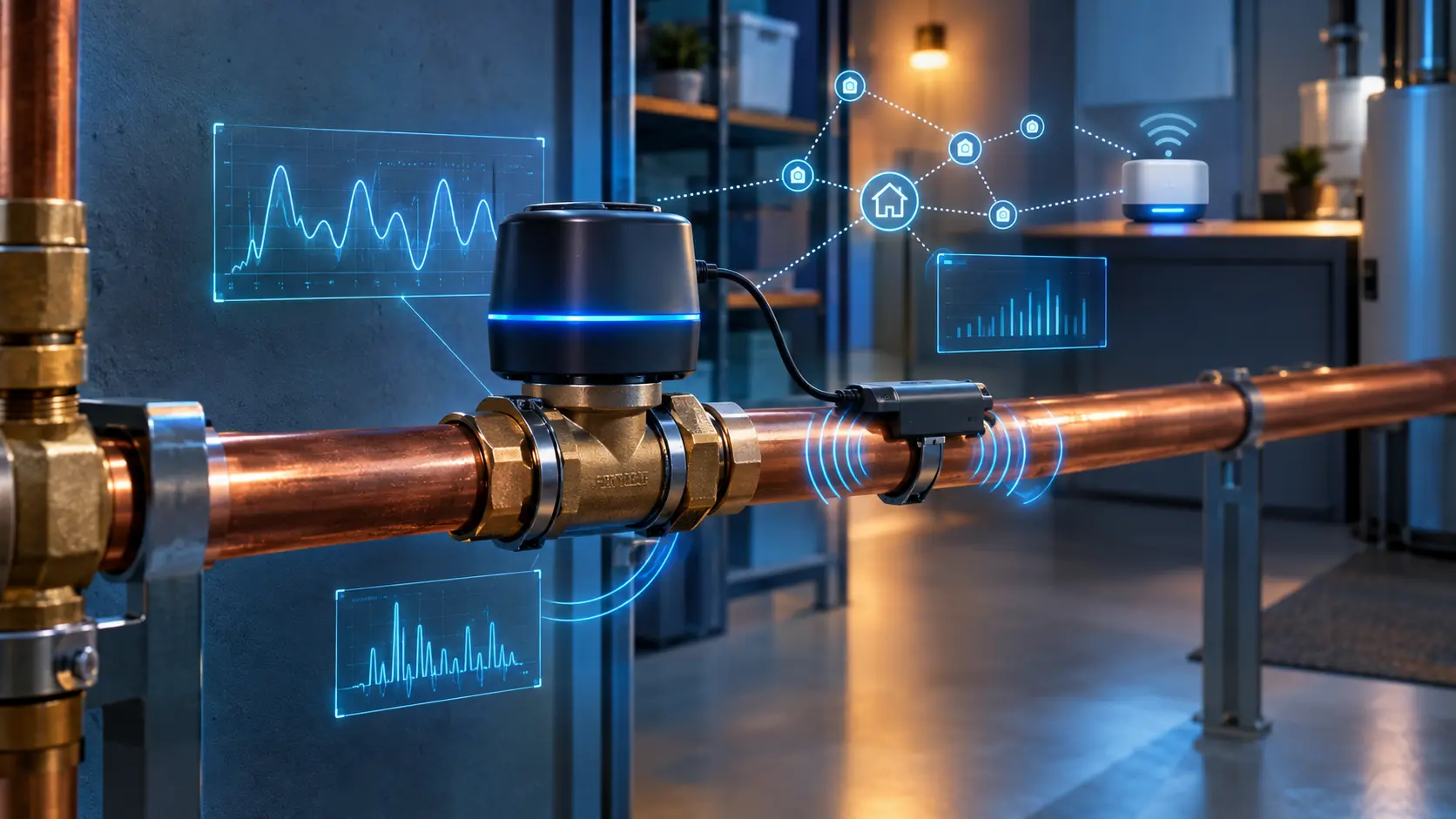
The residential Internet of Things (IoT) landscape is undergoing a fundamental architectural pivot. For years, consumer-grade smart home devices functioned primarily as passive monitoring nodes—sending basic telemetry to cloud servers and firing off simple push notifications when an anomaly occurred. However, this model has proven insufficient for high-stakes environmental hazards, particularly residential and commercial water damage. Today, the smart home industry is actively shifting toward autonomous, edge-driven remediation systems capable of instant physical actuation without reliance on external cloud services.
At the epicenter of this transformation is smart water infrastructure. catastrophic water leaks represent one of the largest single sources of property loss globally, vastly outstripping damages caused by home fire or theft. To combat this issue, hardware engineers, system architects, and software developers are converging three core technological paradigms: Edge Machine Learning (TinyML) for micro-leak detection, cross-platform interoperability through the Matter standard specification, and enterprise-grade telemetry-to-API integrations directly linking physical devices with insurance underwriters. This article explores the deep engineering architecture, signal processing mechanisms, and enterprise protocols driving modern smart water management systems.
Edge AI and Micro-Signal Processing: Detecting Leaks at the Hardware Frontier
Traditional water monitoring relied on basic flow meters that registered continuous volumetric throughput. If a pipe burst and hundreds of gallons flowed through the system within an hour, the device tripped a shutoff mechanism. While effective for catastrophic breaches, this reactive model failed to address silent micro-leaks—pinhole ruptures, weeping pipe joints, or slow toilet flapper leaks that discharge as little as one drop per minute. Over time, these undetected leaks rot structural subfloors, cultivate toxic mold, and consume thousands of gallons of municipal water.
Ultrasonic Wave Sensing and Micro-Pressure Decay Dynamics
Modern point-of-entry smart shutoff devices—such as those pioneered by Phyn Plus ultrasonic technology and StreamLabs—bypass mechanical impellers in favor of non-intrusive ultrasonic transducers and high-frequency fluid dynamic pressure sensors. Ultrasonic flow meters deploy piezoelectric transducers to transmit acoustic sound waves upstream and downstream through the water column.
By accurately calculating the microsecond time-of-flight differences between upstream and downstream acoustic waves (based on Doppler shift and sound attenuation), the system computes fluid velocity with millimeter-level precision. This non-invasive mechanism introduces zero moving parts into the water line, preventing mineral buildup, mechanical degradation, and pressure drops across the main intake line.
Simultaneously, micro-pressure decay sensing allows devices like Flo by Moen to perform automated daily health checks. During designated off-peak hours (typically deep night), the valve executes a full or partial micro-closure, isolates the household plumbing system, and continuously logs static line pressure. If the closed system experiences a pressure drop exceeding fractions of a single pound per square inch (PSI) over a timed interval, the system flags a micro-leak long before structural water damage manifests visually.
TinyML on Microcontrollers: Eliminating Latency and Cloud Dependency
Processing high-frequency pressure transient waveforms and acoustic signals at several thousand hertz (Hz) generates significant bandwidth. Streaming raw high-fidelity sensor telemetry to the cloud for real-time analysis is cost-prohibitive, power-inefficient, and creates dangerous latency during emergency conditions. Consequently, hardware engineers are moving inference logic directly onto low-power edge microcontrollers using micro-machine learning frameworks (TinyML).
- Edge Feature Extraction: On-device DSPs (Digital Signal Processors) filter high-frequency sensor streams, calculating fast Fourier transforms (FFT) and time-domain signal envelopes to classify fluid dynamics locally.
- Low-Power Model Execution: Quantized neural network models execute within ultra-constrained memory footprints—often requiring less than 256 KB of RAM on 32-bit ARM Cortex-M4 or Cortex-M33 microcontrollers.
- Zero-Latency Inference: Anomaly detection runs locally in real time. If a pressure signature matches a catastrophic pipe burst waveform, the microcontroller signals the motor driver circuit to actuate the physical valve immediately, without waiting for cloud round-trip acknowledgement.
Household Consumption Profiling and False-Positive Reduction
A primary failure mode of early smart water valves was the generation of false positives. Legitimate household activities—such as filling a swimming pool, running an automated irrigation cycle, or executing continuous multi-stage reverse osmosis filtration—often triggered aggressive safety cutoffs. Edge AI models address this by maintaining continuous, adaptive baselines of household consumption behavior.
Rather than relying on static, hardcoded thresholds, the edge model analyzes temporal patterns, duration, fixture signatures, and flow variability. Over time, the algorithm learns that a continuous 4-gallon-per-minute draw occurring every Tuesday morning at 6:00 AM correlates with an irrigation routine rather than a compromised main line. By continually refining this multi-dimensional behavior matrix on-device, systems significantly suppress false-positive shutoffs while maintaining extreme sensitivity to uncharacteristic leaks.
Protocol Standardization and Matter Ecosystem Integration
Historically, smart water valves operated within proprietary, siloed hardware ecosystems. Interfacing a water valve with a third-party security panel or smart hub required complex custom integrations, brittle cloud-to-cloud APIs, or community-maintained scripts. The advent of unified connectivity protocols has fundamentally resolved this fragmentation.
Unifying Smart Home Ecosystems via Matter
The Matter smart home standard, governed by the Connectivity Standards Alliance (CSA), establishes an IP-based, open-source application layer that operates seamlessly across local physical networks (Thread, Wi-Fi, and Ethernet). By adopting native Matter profiles for smart valves and environmental sensors, hardware developers ensure their devices can simultaneously communicate with Apple Home, Google Home, Amazon Alexa, Samsung SmartThings, and local home automation platforms without vendor lock-in.
Because Matter operates entirely over local area networks using IPv6, control signals bypass external internet routing entirely. If a remote water sensor detects moisture under a washing machine, it broadcasts an emergency payload directly across the local Thread mesh or Wi-Fi network. The main water shutoff valve receives the packet and actuates instantly, even if the residential internet service provider is experiencing an outage.
Cross-Device Event-Driven Logic Pipelines
Native Matter integration allows hardware developers and automation architects to construct sophisticated, multi-device safety routines across disparate hardware brands. By breaking down vendor silos, smart water valves become active participants in broader home security and environmental pipelines:
- Armed Away State Triggers: When a user arms their smart home security system to “Away” mode, an automated rule updates the smart valve’s active operational state. The edge AI model transitions to a hyper-sensitive monitoring profile, lowering the continuous draw threshold and triggering a shutoff much faster than when the home is occupied.
- Environmental Sensor Fusion: If an integrated smart HVAC thermostat reports freezing interior ambient temperatures alongside an unheated basement sensor, the system can command the main valve to close while opening low-point drain valves to prevent pipe freeze-burst catastrophes.
- Occupancy-Aware Shutoff Delays: When motion sensors detect active occupants within the home, manual long-duration water uses (such as pressure washing or garden maintenance) are granted temporary tolerance windows without triggering automatic interventions.
Long-Range Wireless Infrastructure: The Role of LoRa Radios
While Matter over Thread and Wi-Fi excels within the primary residential footprint, smart water infrastructure often spans challenging physical environments. Main shutoff valves, water meters, and irrigation pits are frequently situated deep underground, inside reinforced concrete utility vaults, or at property boundaries hundreds of feet away from the primary Wi-Fi access point.
To solve this physical layer challenge, long-range systems (such as YoLink and the Bulldog Valve Robot) deploy LoRa (Long Range) radio technology operating on sub-GHz ISM radio bands (e.g., 915 MHz in North America, 868 MHz in Europe). LoRa’s Chirp Spread Spectrum (CSS) modulation offers extraordinary link budgets, allowing signals to penetrate thick concrete barriers, soil, and dense building structures across miles of open air. In modern architecture, hybrid hubs bridge these sub-GHz LoRa end-nodes back into the local Matter or IP network, extending the operational perimeter of smart water protection across expansive estates and multi-structure agricultural properties.
Mission-Critical Hardware Architecture and Fail-Safe Engineering
Unlike a smart light bulb or a ambient temperature sensor, a smart main water shutoff valve is a mission-critical infrastructure component. Physical failure, dynamic electrical stalls, or software freezes can result in tens of thousands of dollars in real estate destruction or complete loss of utility services. Consequently, mechanical and electrical engineering standards in this category rival enterprise industrial safety systems.
Autonomous Local Actuation and Physical Point-of-Entry Integrity
The primary design mandate for smart valve hardware is absolute autonomy from cloud dependencies. All critical safety logic must reside in volatile and non-volatile local memory directly on the primary board. When an emergency event is triggered—whether via a hardwired leak sensor lead, a local RF transmission, or an edge AI pressure decay detection—the local MCU directly commands the motor bridge circuit.
From an actuation standpoint, physical reliability is paramount. Main water supply lines experience significant mineral scaling (calcium and magnesium deposits) and high static line pressures (often exceeding 80 PSI). Valve actuators must generate immense mechanical torque to break through internal mineral friction after months of inactivity. Engineers address this by utilizing heavy-duty brass ball valves driven by high-ratio metal gear trains, paired with regular, automated micro-jog routines that cycle the valve by a few degrees periodically to clear internal scaling without interrupting household water supply.
Power Redundancy: Cellular Backups, Capacitors, and Battery Fail-Saves
Catastrophic structural events are rarely isolated. Severe storms, freeze events, and municipal grid failures often cause simultaneous power grid outages and broadband interruptions. A smart valve that loses power or network connectivity during a storm is fundamentally useless.
| Resilience Subsystem | Primary Component | Engineering Purpose |
|---|---|---|
| Primary Power Failover | LiFePO4 / High-Capacity Li-ion Battery Packs | Maintains board telemetry, micro-processor operational states, and RF listening modes during grid power outages. |
| Mechanical Actuation Reserve | Supercapacitor Banks | Stores rapid electrical charge to deliver high peak currents needed by heavy gear-motors during mechanical emergency closure, even if batteries are degraded. |
| WAN Network Redundancy | Integrated eSIM / Cellular Fallback (LTE-M / NB-IoT) | Transmits outbound emergency alerts and diagnostic logs to enterprise servers when local Wi-Fi router loses power or broadband connectivity. |
| Physical Override | Manual Mechanical Clutch / Hex Key Port | Allows building engineers and homeowners to manually open or shut the main valve during complete electrical breakdown. |
The Enterprise Bridge: Automated B2B Telemetry and Insurance APIs
The technological evolution of smart water shutoffs extends beyond consumer hardware into enterprise B2B software ecosystems. Property and Casualty (P&C) insurance providers represent major stakeholders in smart home technology. By incentivizing the installation of verified, active risk-mitigation hardware, insurance carriers can reduce water damage claim frequency by over 70% across their insured portfolios.
Programmatic Certificates of Installation and Cryptographic Trust
Historically, homeowners claiming smart home insurance premium discounts submitted manual paper receipts or self-reported equipment installations. This created significant administrative friction and left carriers exposed to fraud—such as customers purchasing hardware to claim discounts and subsequently uninstalling or disabling the hardware.
Modern smart water systems eliminate manual validation through programmatic, end-to-end B2B integrations:
- Cryptographic Device Provisioning: During manufacturing, each physical valve is provisioned with a unique cryptographic hardware security module (HSM) identity and keypair.
- Automated Installation Verification: Upon successful installation and physical calibration, the device executes a self-diagnostic sequence (testing motor torque, pressure decay response, and cellular handshake).
- Direct API Attestation: The device vendor’s cloud platform generates a digitally signed Certificate of Installation payload and transmits it directly via REST or GraphQL APIs to enterprise insurance portals (e.g., State Farm, Hippo, Chubb, Nationwide).
Real-Time Health Monitoring and Dynamic Policy Qualification
To retain premium discounts and coverage eligibility, insurance carriers increasingly require continuous telemetry attestation. Through secure webhook events and standardized enterprise APIs, the hardware vendor’s backend continuously transmits encrypted “heartbeat” status logs to the carrier’s underwriting engines.
If an owner disconnects their device, leaves it in a manual bypass state for extended periods, or ignores critical low-battery alerts, the system automatically logs a policy compliance exception. Conversely, maintaining continuous 24/7 telemetry validation can unlock dynamic policy structures, lower deductibles, and automatically trigger immediate loss-mitigation services—such as dispatching an emergency plumbing technician automatically if a major leak is mitigated while the homeowner is out of the country.
Leading Hardware Implementations in the Market
Several market leaders have established high engineering benchmarks in the smart main water shutoff and monitoring sector. Each leverages distinct structural hardware choices and cloud architecture strategies to address specific installation constraints.
Flo by Moen
Flo by Moen is widely recognized for its deep enterprise integration with top-tier insurance carriers. Built directly into the primary water inlet, it utilizes inline micro-pressure decay sensing alongside micro-turbine flow telemetry. Its proprietary engine performs continuous pressure testing to isolate tiny pinhole leaks. Through extensive B2B cloud pipelines, Flo directly bridges user policy management with automated claims mitigation systems.
Phyn (Phyn Plus)
Co-developed through a partnership between Belkin and Uponor, the Phyn Plus device focuses on high-precision ultrasonic acoustic wave sensing. By taking pressure readings 240 times per second without placing any moving mechanical impellers directly into the water stream, Phyn eliminates physical wear and tear entirely. Its advanced edge-computing algorithms analyze ultrasonic high-frequency sound waves to measure fluid dynamics and detect complex leak signatures across entire multi-story structures.
StreamLabs Control
StreamLabs focuses heavily on non-invasive ultrasonic flow sensing and scalable smart ecosystem integration. Designed for simple integration across residential and light commercial structures, StreamLabs leverages real-time flow rate processing to trigger automatic local cutoffs and delivers seamless API endpoints for local network home automation and enterprise management platforms.
YoLink / Bulldog Valve Robot
Targeting long-range resilience and retrofittable installations, YoLink combines sub-GHz LoRa communication protocols with external mechanical ball-valve actuators (such as the Bulldog Valve Robot). Rather than requiring a plumber to cut into the main water line, these robotic actuators mount directly over existing, manual quarter-turn ball valves. Coupled with LoRa sensors that operate reliably across long distances, YoLink offers an economical, highly scalable option for outbuildings, farms, and complex multi-building setups where Wi-Fi coverage fails.
Frequently Asked Questions (FAQ)
How does TinyML micro-leak detection differ from traditional flood sensors?
Traditional flood sensors are reactive point-of-detection devices that must come into direct physical contact with standing water (e.g., water pooling on the floor under a leaking water heater). TinyML micro-leak detection operates centrally at the main incoming water line using ultrasonic or pressure dynamic algorithms. It analyzes total fluid flow, micro-pressure drops, and acoustic velocity profile changes, allowing it to detect hidden, in-wall pipe leaks, running toilets, or pinhole fractures long before water ever reaches the floor to touch a physical leak puck.
Will a Matter-enabled smart water valve still turn off my water if my Wi-Fi goes down?
Yes. The core emergency safety logic and actuation motor drivers reside locally on the physical microcontroller board within the valve itself. Furthermore, the Matter standard operates over local IPv6 networks (via Wi-Fi or Thread mesh). This means that local direct device-to-device automation rules—such as a local Thread leak sensor signaling the main valve to close—will execute seamlessly across your local network even if your internet service provider experiences a complete outage.
Why are insurance companies offering discounts for smart main water shutoffs?
Water damage claims represent billions of dollars in annual payouts for property and casualty insurers, far surpassing damage caused by fire and theft combined. A point-of-entry smart water shutoff valve capable of automatically stopping the flow of water upon detecting a burst pipe or prolonged micro-leak reduces the severity of loss events by up to 70-90%. Insurers offer premium discounts and hardware subsidies because programmatic risk mitigation directly lowers their underwriting loss ratios.
What happens if grid power fails during a major storm and a pipe bursts?
Enterprise-grade smart water shutoff systems incorporate multi-tiered power fail-safes. The devices typically feature integrated rechargeable backup battery systems (such as LiFePO4 cells) to keep local processing and RF listening circuits active. To handle the high mechanical torque required to actuate heavy brass valves, modern units incorporate supercapacitor banks that hold sufficient electrical charge to physically drive the gear-motor closed, even if primary power is severed.
Conclusion and Future Outlook
The transformation of smart water infrastructure represents a macro-trend across the broader Internet of Things ecosystem: the transition from passive alerting nodes to autonomous, edge-intelligent remediation systems. By combining high-frequency ultrasonic signal processing, low-power TinyML models on local MCUs, cross-platform Matter protocol integration, and direct enterprise insurance APIs, smart water valves have elevated water safety from a consumer luxury to an essential property risk-management standard.
Looking ahead, the convergence of smart infrastructure will extend further into distributed machine intelligence and predictive utility management. We can anticipate hardware designs that integrate smart water management directly with local power grid management, smart heating infrastructure, and municipal water supply monitoring. As edge AI models grow lighter and cross-platform communication becomes standard across all hardware manufacturers, autonomous property protection will become an invisible, ubiquitous standard—safeguarding built environments against environmental threats in real time without requiring human intervention.